
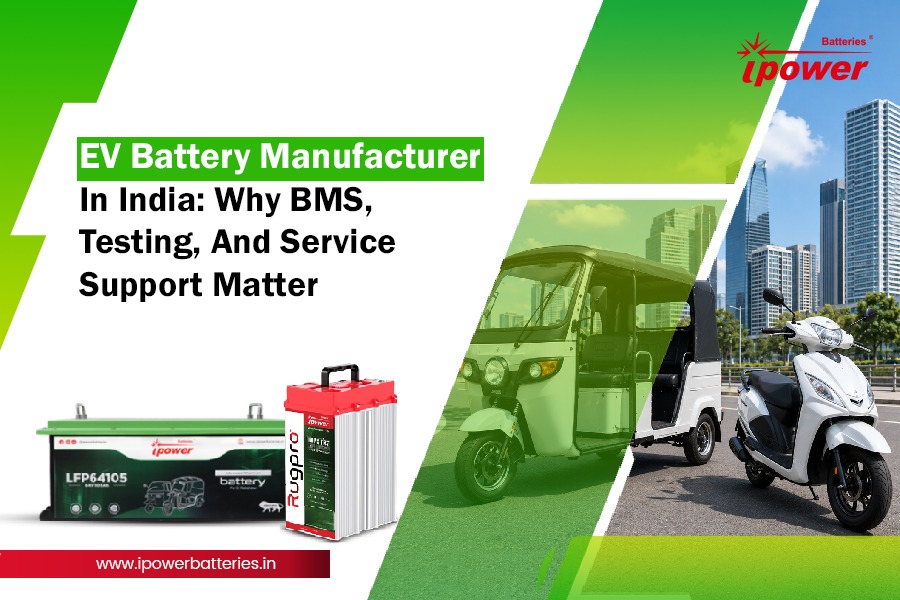
In EV batteries, the real difference does not always show on the label.
Two batteries may have the same voltage. Same Ah rating. Similar outer case. Similar range claim. But once they go into an e-scooter, e-rickshaw, e-cycle, or commercial EV, the difference starts showing.
One battery runs smoothly. Another heats up. One charges properly. Another cuts off under load. One brand gives service support. Another leaves the dealer handling complaints alone.
That is why choosing the right EV Battery Manufacturer in India matters. At Ipower, we do not look at an EV battery as just a battery pack. We look at how it will work on real roads, with real riders, real charging habits, and real service needs.
BMS Is Not Just A Technical Feature
Many buyers ask about voltage, capacity, and price first. That is normal.
But in lithium batteries, the Battery Management System is just as important. The BMS controls how the battery charges, discharges, handles temperature, and protects itself during daily use.
A weak BMS may not create problems on the first day. The battery may run fine in the beginning. But later, issues can come up: sudden cut-off, heating, uneven charging, low range, or poor performance under load.
For a rider, these are not technical issues. They are daily problems.
The vehicle stops. The range drops. The battery takes longer to charge. The customer comes back with a complaint.
This is why, as a Lithium Ion Battery Manufacturer in India, we focus on smart and safe BMS design. Ipower’s battery solutions include BMS and remote monitoring features across lithium-ion applications, which helps improve control, safety, and battery visibility in real use.
Testing Decides What Happens After Dispatch
A battery should not leave the factory just because it turns on.
That is not enough. EV batteries face heat, vibration, charging stress, road shocks, overload, and long working hours. An e-rickshaw battery faces a different load than an e-scooter battery. A fleet battery faces different pressure than a personal-use battery.
So testing has to go beyond basic checking.
At Ipower, our manufacturing setup includes automated production lines, testing labs, capacity testing, charge-discharge analysis, safety verification, and quality-control processes before dispatch. These checks matter because a battery has to perform after installation, not only inside the factory.
For dealers, OEMs, and fleet operators, this is important. One weak battery pack can create repeated service visits, vehicle downtime, and customer trust issues.
A properly tested lithium-ion battery pack reduces those risks.
EV Battery Service Matters More Than People Think
Many companies talk about battery supply. But EV battery work does not end after supply.
Once the battery goes into the market, real use begins. Riders charge batteries in different ways. Vehicles run in different conditions. Some users overload. Some use the wrong charger. Some ignore early warning signs. Some batteries need balancing, checking, firmware updates, or professional inspection.
This is where service support becomes important. Ipower has introduced a network of service centres for EV battery care. The service programme focuses on battery maintenance, trained staff, tools, BMS firmware updates, preventive and corrective battery care, and faster turnaround time for EV battery issues.
For riders, this means fewer delays when a problem comes up.
And for dealers, it means they do not have to handle every complaint without technical support.
Lastly For OEMs and fleet owners, it means better customer confidence and less vehicle downtime.
Why This Matters When Choosing A Manufacturer
A good EV battery is not only about cells.
It is about the full system. The cells should be matched properly. The BMS should protect the pack. The design should suit the vehicle. The battery should be tested before dispatch. And support should be available after sale.
This is what separates a serious EV Battery Manufacturer in India from an average battery seller.
At Ipower, we work across electric mobility and energy applications, including e-bikes, e-scooters, e-rickshaws, telecom, solar, inverter, and commercial ESS solutions. That matters because each application teaches something different about load, charging, backup, safety, and service needs.
An EV battery cannot be selected only by price. It should be selected by application, safety, testing, support, and long-term reliability.
Conclusion
In electric vehicles, the battery decides more than range.
It decides safety, running time, charging behaviour, customer trust, and service cost.
That is why BMS, testing, and service support should never be treated as small points. They are the parts that decide how the battery performs after it leaves the factory.
As an EV Battery Manufacturer in India, we believe a battery should do more than power the vehicle. It should keep the vehicle dependable in daily use.
Because in the EV market, the strongest battery brand is not the one that only sells more packs.
It is the one that supports the battery after it starts working on the road.