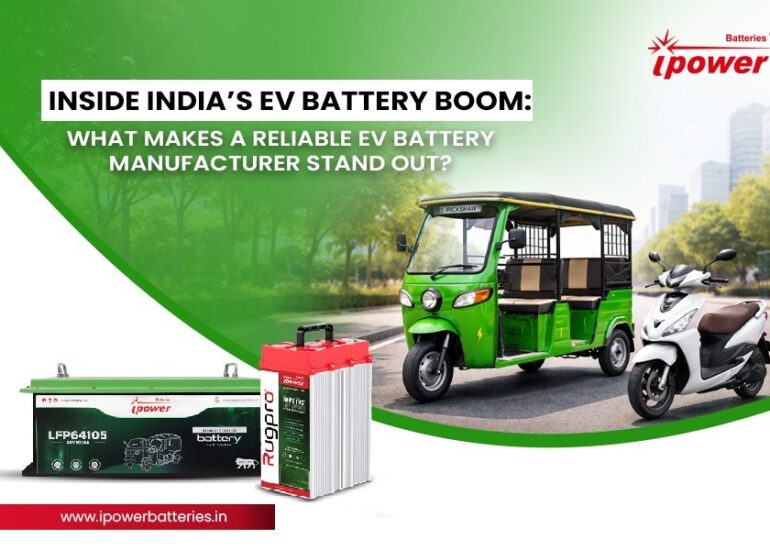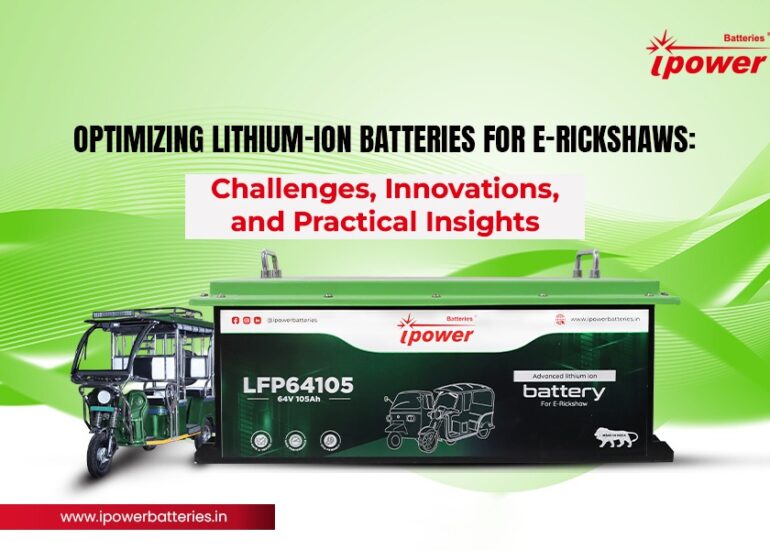
For an electric vehicle OEM, no supplier decision carries more weight than the battery partner. The battery is typically 35–45% of the vehicle’s bill of materials, the number one driver of range and performance claims, the component most scrutinised by regulators — and the part most likely to determine whether your brand is trusted or trending for the wrong reasons.
India’s EV boom has attracted hundreds of battery suppliers, from serious manufacturers to importers rebadging generic packs. Having supplied certified lithium-ion batteries to two-wheeler and three-wheeler OEMs since 2019 — including global brands entering the Indian market — we at Ipower Batteries have a clear view of what separates a durable partnership from an expensive mistake. Here is the checklist we would use if we were on your side of the table.

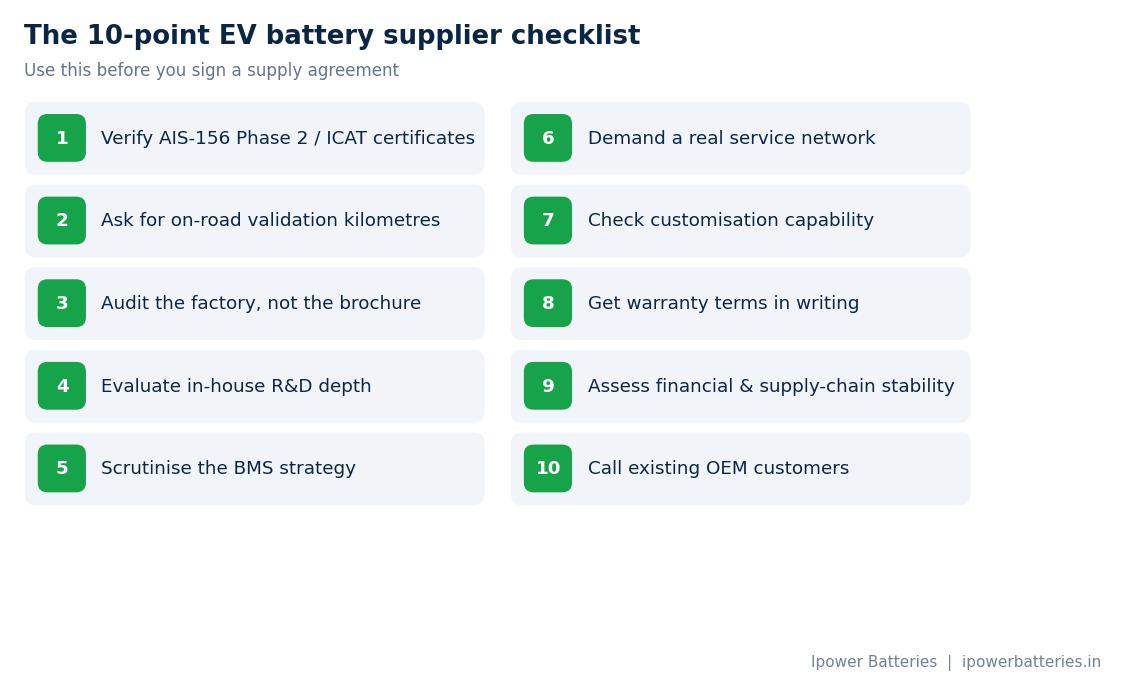
1. Verify Certifications — Don’t Take Them on Faith
The non-negotiable baseline for EV batteries in India is AIS-156 (Amendment III) Phase 2, certified by an accredited agency such as ICAT. Ask for the actual certificate, check that it covers the specific pack model and capacity you are buying, and confirm the certification is current.
Go a level deeper on quality systems: IATF 16949 (the automotive quality management standard), ISO 9001, ISO 14001, and ISO 45001 indicate a manufacturer that runs disciplined processes, not just a workshop that passed one test. Ipower operates under all of these, and our early clearance of AIS-156 Phase 2 for NMC, LFP — and India’s first certified LMFP packs — reflects an R&D-first culture rather than a compliance-last scramble.
2. Insist on Road Validation, Not Just Lab Results
Lab certification proves a design can pass controlled tests. Indian roads administer a different exam: sustained 45°C heat, dust ingress, monsoon flooding, relentless vibration, and vehicles loaded well beyond spec. Ask every prospective supplier: how many on-road kilometres has this exact pack design completed, and where?
Before our certified packs reached customers, they logged 40,000+ km of road validation for NMC two-wheeler packs and 60,000+ km each for LFP two-wheeler and three-wheeler packs. That data changed our designs in ways no lab test would have.
3. Audit the Factory, Not the Brochure
A serious battery partner will welcome a plant audit. Look for:
- Cell incoming inspection and grading — pack quality starts with matched cells
- Automated welding and assembly — manual spot-welding at scale is a defect factory
- End-of-line testing on every pack: capacity, insulation, BMS function, charge/discharge
- Traceability — can they trace any field failure back to cell lot and assembly station?
- Real production capacity — Ipower’s 50,000 sq ft Kundli facility produces 500+ packs per day with headroom to scale
4. Evaluate R&D Depth
Battery technology is moving fast — chemistries, cell formats, BMS intelligence, and regulations all evolve yearly. A partner without genuine R&D will always be one generation behind. Ask whether the manufacturer has a government-recognised in-house R&D centre (Ipower does), how many engineers it employs, and what it has brought to market recently. Our launch of Rugpro — India’s first AIS-156 Phase 2 certified LMFP packs — came directly from that investment.
5. Scrutinise the BMS Strategy
The Battery Management System determines real-world safety, usable life, and serviceability. Probe beyond “yes, it has a BMS”: active balancing? temperature sensor count and derating logic? data logging? IoT connectivity for fleet diagnostics? A supplier who designs or deeply specifies their own BMS — rather than accepting whatever ships with imported packs — controls the variable that matters most.

6. Demand a Real Service Network
Your customer’s battery problem becomes your brand problem within hours of a social media post. Battery service in India has historically meant shipping packs across the country and waiting weeks. That model is broken.
Ask: how many authorised service centres does the supplier operate, where are they, and what is the documented turnaround time? Ipower has built a network of 200+ sales and service centres across India, and our dealer partners consistently tell us that local, fast battery service is the single biggest driver of end-customer trust in their EVs.
7. Check Customisation Capability
Your vehicle is not generic; your battery shouldn’t be either. Form factor, mounting, connector standards, communication protocol (CAN/RS485), charge profiles, and capacity variants should be engineered to your platform. A manufacturer with in-house design capability can co-develop with your team; an importer can only offer a catalogue.
8. Understand the Warranty — in Writing
Get clarity on: warranty period and cycle count, the capacity-retention threshold that defines a claim, what usage data will be used to assess claims, and turnaround commitments. A supplier with confidence in their engineering offers transparent, data-backed warranty terms — and an IoT-enabled BMS makes claim resolution fast and fair for both sides.
9. Assess Financial and Supply-Chain Stability
Your battery partner must be around for the life of your vehicles. Consider the company’s heritage and backing — Ipower Batteries grew out of Computech Systems, a power-solutions business serving Indian enterprises since 1992 with over 10 million batteries sold — and its cell-sourcing relationships, multi-chemistry flexibility (NMC/LFP/LMFP), and exposure to commodity swings.
10. Talk to Existing Customers
Finally, the simplest test: ask for OEM references and actually call them. Ask about delivery consistency, field failure rates, engineering responsiveness, and how the supplier behaved when something went wrong — because at some point, something always does. Consistency of quality, consistency of delivery, and consistency of safety are the promises that matter; verify that current customers experience all three.
The Bottom Line
Choosing a battery partner is choosing who you will build your reputation with. Certifications set the floor; road validation, manufacturing discipline, R&D depth, BMS intelligence, and a real service network determine everything above it.
If you are an OEM, fleet operator, or distributor evaluating battery partners, we invite you to put Ipower Batteries through this exact checklist — audit our Kundli facility, review our ICAT certificates, and speak with the OEMs we already serve. We built the company to pass this test.
Put us through this checklist. Audit our Kundli facility, review our ICAT certificates and speak to the OEMs we already supply.