
With the increasing popularity of hustle culture, E-rickshaws have become the unsung heroes of urban transport for quick and short distances. They’re efficient, sustainable, and have become vital for last-mile connectivity. But here’s the thing,
However, without a good lithium-ion battery for E-rickshaw, it can’t achieve their peak performance. And let’s be honest, these batteries are a bit tricky. If you push them too hard, ignore their quirks, or skip maintenance, you’ll see the effects in performance afterwards. This leads to a shorter range, higher costs, and frustrated operators.
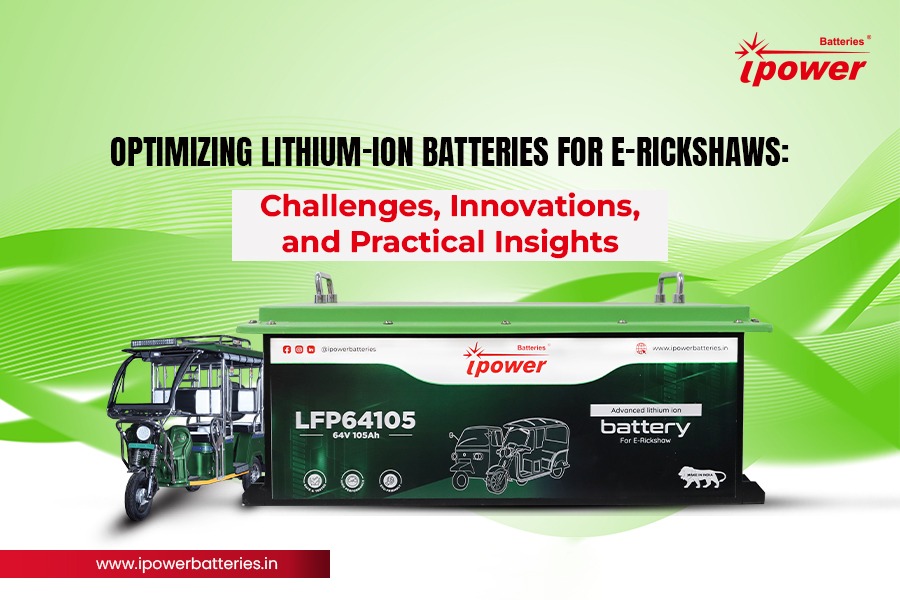
Ipower, a skilled maker of Lithium Ion Batteries for E Rickshaws, knows these concerns. We offer custom lithium-ion power solutions that fit Indian conditions.
So, what does it take to really optimize them? Let’s break it down, piece by piece, in this blog.
Why Battery Optimization Matters for E-Rickshaws
The E-rickshaw is operated in harsh environments that require frequent stopping and starting, a large number of cycles on the battery, and long periods of use each day. Consequently, the battery’s performance directly affects the E-rickshaw’s availability for use.
Therefore, Ipower offers a properly designed Lithium Ion Batteries for E Rickshaws that will provide an E-Rickshaw with additional energy density and consistent output; as a result, a driver will benefit from an extended range of motion, reduced recharging time, and lower maintenance expenses.
Fleet owners and e-rickshaw owners will experience a more predictable and lower total cost of ownership from this type of battery.
Key Challenges in Lithium-Ion Battery Optimization
Optimisation has multiple challenges despite clear advantages. Thermal management is a major concern as battery life is decreased through overheating and unsafe battery conditions. Inconsistent charging practices will also contribute to the fast degradation of the battery (cell).
Another challenge is a lack of proper battery management systems causing uneven balancing of the cells; therefore, it limits how much power can be used. As a result, there will be a drop in performance sooner than expected. Weight optimization is another challenge; e-rickshaws should be designed to have lightweight systems while still maintaining the structural integrity of the system.
These challenges need an optimal solution involving a combination of engineering precision and “smart” electronics.
Ipower, leading manufacturer Lithium Ion Batteries for E Rickshaws understands that addressing these issues requires a combination of engineering precision and smart electronics.
Innovations Driving Smarter Battery Performance
Innovations have significantly transformed the Lithium Ion Battery for E Rickshaw ecosystem. Advanced BMS now monitors voltage, temperature, and current in real time. Consequently, batteries operate within safe parameters and deliver consistent power.
Ipower outsources advanced BMS technology, making our Lithium Ion Batteries for E Rickshaws stand out.
In addition, improved cell chemistry enhances cycle life while supporting faster charging. Manufacturers also integrate modular battery designs, which simplify replacement and scalability. As a result, downtime decreases, and service efficiency improves.
Moreover, intelligent thermal regulation systems actively dissipate heat. Therefore, batteries remain stable even during prolonged operations.
Connecting the Dots
Challenges, innovations, and operational disciplines also don’t lie far apart from each other. Sometimes, they complement each other. However, a bright BMS never acts as a substitute for poor charging habits, although a combination of the two acts as a perfect energy for its optimal performance.
The future of e-rickshaw lies in a combination, not the mere use, of challenges, innovations, and operational disciplines.
Reliability and Safety: The Core of Optimization
Reliability defines battery value in commercial e-rickshaw applications. Optimized lithium-ion batteries undergo rigorous testing to ensure resistance to vibration, overcharging, and deep discharge. Consequently, safety risks are reduced significantly.
Furthermore, certified protection mechanisms prevent short circuits and thermal runaway. As a result, operators gain confidence in long-term deployment. Reliability, therefore, becomes a competitive advantage rather than an afterthought.
Last Thought
The optimization of the Lithium Ion Batteries for E Rickshaws is a strategic investment with respect to efficiencies, safety, and profits. With new technologies and enhanced materials, as well as the utilization of Intelligent Design features, Lithium-Ion Battery Technology has been improved to meet the demands of modern urban mobility levels.
In short, optimized batteries will provide greater sustainability in the transport sector while contributing to the expansion of the electric transport infrastructure.
FAQs
Q1. How does optimization improve battery life?
Optimization controls temperature, charging cycles, and cell balance, which reduce degradation and extends usable life.
Q2. Are optimized lithium-ion battery for e-rickshaw safe for daily commercial use?
Yes. Advanced protection systems and certified testing ensure high safety standards under continuous operation.
Q3. Does an optimized battery reduce operating costs?
Absolutely. A longer lifespan, reduced downtime, and higher efficiency lower the total cost of ownership.